When movement feels different: MSM and the role of organic sulfur
Do you know that feeling when your body needs a sort of “warm-up period” after getting up in the morning? Perhaps you notice it when you first climb the stairs or after a long day of sitting at work: your movements no longer feel quite as light and springy as they used to. It’s less of a sudden change and more of a quiet realization that the flexibility and regenerative power of your musculoskeletal system require more attention than they did just a few years ago.
When that feeling of lightness fades, many people look for ways to support their body’s natural mobility and resilience. In this context, a specific substance keeps cropping up in modern nutritional science: MSM (methylsulfonylmethane). This organic sulfur is closely linked to the topics of regeneration and tissue structure. But what exactly lies behind this chemically sounding name, and why is this often underestimated element so essential for our daily well-being?
What is MSM, and what role does sulfur play in the body?
Methylsulfonylmethane, also known in professional circles as dimethyl sulfone, is a natural, organic sulfur compound. Although the word “sulfur” often brings to mind industrial processes or the distinctive smell of volcanic springs, sulfur in its organic form is an essential building block of the human body. In fact, our bodies consist of about 0.2% sulfur. That may sound negligible at first, but a comparison highlights its significance: We carry five times more sulfur in our bodies than magnesium and even forty times more than the vital mineral iron!
Sulfur bridges as biological structural supports
Why is sulfur so indispensable? It acts as a central building block for a multitude of enzymes, hormones, and amino acids. Particularly fascinating for our mobility are the so-called sulfur bridges. These chemical cross-links are responsible for ensuring that proteins and enzymes maintain their correct spatial structure. You can think of them like the rungs of a ladder that hold everything together stably. Without this structural integrity, many biological processes in your body could not function smoothly. Additionally, sulfur is an integral component of substances such as insulin or the powerful antioxidant glutathione, which plays a key role in protecting our cells from oxidative stress [1].
Focus on MSM: Mobility and regeneration
Why MSM is often mentioned in connection with joints
In sports science and nutrition, MSM is often referred to as a “building block for joints.” This is primarily because sulfur-containing amino acids such as methionine and cysteine form the basic substance of our cartilage, tendons, ligaments, and all connective tissue. When we move, enormous forces act on our joints. Well-nourished cartilage acts as a shock absorber in this process. Studies have extensively investigated how the targeted intake of organic sulfur can help maintain the normal function of these shock absorbers and support the body during periods of stress [2].
Research findings on joints and oxidative stress
Scientific studies suggest that MSM may have a positive influence on the body’s regenerative processes. It has been observed that supplementation can help promote overall well-being in the musculoskeletal system by harmonizing the body’s response to daily stressors. In clinical observations, users often reported an improved quality of life during everyday activities, as their movements felt smoother again [3].
Skin, hair, and allergies
Building blocks for your appearance
Sulfur doesn’t just do valuable work “on the inside.” Our skin, hair, and fingernails are largely made up of proteins such as keratin and elastin. Since these proteins rely on sulfur compounds for their strength and elasticity, MSM is often referred to as the “beauty mineral.” Studies have shown that even moderate amounts of MSM can help improve the appearance of the skin and support the structure of hair and nails [4].
A gentle companion during seasonal challenges
Interestingly, there is also evidence that organic sulfur may support well-being during hay fever season. In observational studies, participants reported that their typical respiratory symptoms associated with seasonal allergies felt less bothersome after regular intake of MSM, and their overall energy levels increased [5].
Sports and muscles: Powerful support
Help with sports-related muscle damage
After an intense workout, muscles feel heavy and sore. During exercise, tiny microtraumas occur in the tissue that need to be repaired. Research suggests that short-term, targeted use of MSM powder or capsules can increase the body’s antioxidant capacity [6]. This can help minimize exercise-induced muscle damage and shorten recovery time after exercise.
Usage and selection: Powder, tablets, or capsules?
Differences in usage and selection criteria

MSM is currently available in three common forms, each with its own benefits:
- MSM powder: This is the purest form and offers great flexibility in dosing. You can simply stir it into water, cold tea, or juice. Since MSM has a slightly bitter taste, many people prefer to mix it with fruit juices rich in vitamin C.
- MSM tablets: These are the ideal choice if you prefer a high-dose form. Tablets often offer a higher concentration of MSM per unit than capsules, meaning you need to take fewer of them to reach your desired daily intake. They are also very stable and convenient for easy supplementation.
- MSM capsules: They are the convenient solution for everyday use or when traveling. They are tasteless and allow for precise dosing without the need for a scale.
Taking MSM correctly: Dosage and daily intake
For effective support, the literature often recommends a daily intake of approximately 2,000 mg to 3,000 mg. Scientific studies have even classified amounts up to 4,000 mg per day as safe and well-tolerated [7]. It is best to take MSM in two divided doses (e.g., in the morning and at noon) with plenty of liquid.
Overview: MSM checklist for your daily routine
Category |
Details & Tips |
Optimal dosage |
Usually 2,000 mg to 4,000 mg daily [7] |
Best sources |
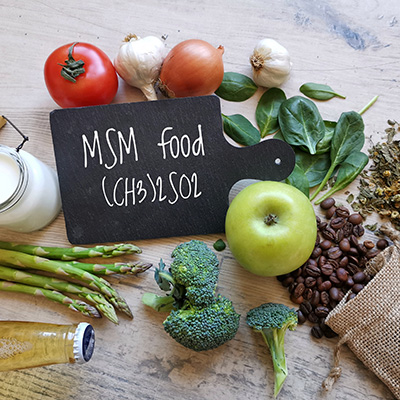
Meat, eggs, onions, garlic, broccoli |
Serving suggestion |
Combine with vitamin C (improves absorption) |
Waiting time |
The first effects are often noticeable after 2–4 weeks |
Quality features |
High purity (free of anti-caking agents such as magnesium stearate) |
Curious about other topics? Then take a look at our magazine:
- How do our joints work, and how do MSM, glucosamine, and chondroitin support your mobility in the spring?
- Joint pain in men? The upgrade for everyday heroes: A closer look at collagen, MSM, and glucosamine
- Full steam ahead: Stay active this spring with turmeric, boswellia, and ginger
- Everyday stress on the bones: When your body needs more stability
- Glucosamine and chondroitin – The key to healthy joints
FAQ – Frequently Asked Questions
When should you avoid taking MSM?
To be on the safe side, you should avoid taking MSM during pregnancy and breastfeeding, as there is not yet sufficient data available for these sensitive phases. Prior consultation with a doctor is also advisable in cases of severe kidney disease.
Can children take MSM?
Since dosage recommendations were primarily developed for adults, children should only take MSM after explicit consultation with a pediatrician.
What effect does MSM have on mental health?
MSM is not a direct psychotropic drug, but due to its ability to improve physical recovery and its effect on overall energy levels, many users report increased mental alertness and less fatigue in their daily lives [8].
Is MSM good for gout?
Gout requires a specific low-purine diet. MSM can only be considered here as part of general support for joint metabolism, but it is not a substitute for medical treatment.
[1] https://infothek-gesundheit.de/schwefel-funktionen-und-symptome-bei-schwefelmangel
[2] https://www.schmerztherapie-hochrhein.de/komplementaere-verfahren-msm
[3] https://pmc.ncbi.nlm.nih.gov/PMC10346176
[4] https://www.nutritionaloutlook.com/msm-supports-health-hair-and-nails-says-recent-study
[5] https://www.uniklinik-freiburg.de/Methylsulfonylmethan
[6] https://www.tandfonline.com/1550-2783-9-46
[7] https://pmc.ncbi.nlm.nih.gov/PMC5372953
[8] https://www.sueddeutsche.de/msm-wirkung