
Neurotransmitters
All information about "Neurotransmitters" and the related magazine articles can be found here.
Our articles are written clearly and link to scientific studies where relevant. This is how we meet our own standards: we regularly deliver new, high-quality content for you—free of charge, no sign-up required, with the highest possible benefit to you.

Everything About GABA
Effects, Foods, and Practical Tips
Discover the unique properties of GABA, its fascinating role in the nervous system, and how you can easily incorporate it into your daily routine by combining it with the right foods.

Between resting mode and new beginnings: L-threonine in focus
When your head is still barefoot but your calendar is already wearing sneakers
L-threonine suits this in-between time like iced coffee suits late summer: subtle, but just right. Discover how the silent amino acid can give your system gentle structure - in the middle of the transition.

Your rest compass for the summer: Naturally in balance with saffron.
Gentle support from nature for mental serenity and your well-being
Does your inner rhythm sometimes falter in the hustle and bustle of everyday life and does your serenity wane? With saffron, nature offers a valued way to harmonize the carousel of thoughts and cultivate your inner center. Discover here how the red gold can lead you back to new balance and lightness.

Inner peace for hot days, with GABA and rose root extract
Support your nervous system with herbal active ingredients that can reduce stress, stabilize your mood and promote your mental balance even in the summer heat.
Summertime often brings stress due to heat, travel or busy schedules. GABA and the adaptogenic rose root extract help you to get through the summer more calmly by promoting your stress resistance and inner peace. So you can enjoy your emotional balance and greater well-being.
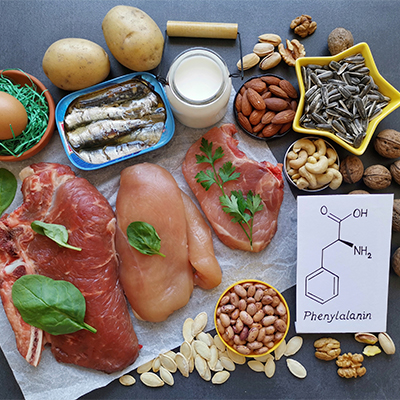
The body needs phenylalanine for this
The amino acid phenylalanine is required for the synthesis of dopamine and serotonin and is also an important building block for proteins. Find out more now.

B6 - a vitamin with many tasks!
The water-soluble vitamin cannot be stored by the body, but is extremely important for us! It is essential for metabolic processes, nerve transmission, hormone production, the immune system and also for regulating homocysteine levels! But despite a balanced diet, are you at risk of vitamin B6 deficiency? Maybe it's due to the contraceptive pill! Read more about this here!

Fitter and stronger with L-Carnosine?
Although carnosine can be produced by the human body, it is a popular supplement among athletes - in powder or capsule form. In this article, you can find out what specific effects it has on performance and what other functions it is involved in.

Calcium or calcium - the important thing is to take it!
Find out what this important mineral is involved in in the body and which is the better form of calcium here!

How curcumin works
Turmeric owes its bright yellow colour to the plant compound curcumin. But curcumin is much more than that.

What are B vitamins - and what does the body need them for?
B vitamins are needed by the body to maintain vital functions. You can find out exactly what tasks they perform and how to recognise a deficiency here.

Tiny Messengers, Big Tasks
Thinking, feeling, learning, sleeping, or simply reaching for a coffee cup: There’s a lot of communication behind all of these things. For our bodies to function, billions of nerve cells must constantly exchange information with one another. And right in the middle of it all? Our neurotransmitters. These tiny chemical messengers help transmit signals from one nerve cell to the next [1].
But how does that actually work? What kinds of neurotransmitters are there, and why do names like dopamine, serotonin, or GABA keep coming up when it comes to mood, sleep, or motivation? That’s exactly what we’re going to take a closer look at now.
What Exactly Are Neurotransmitters?
Let’s start at the very beginning: Neurotransmitters are the body’s own chemical messengers. Their job is to pass information between nerve cells, known as neurons, or from nerve cells to other target cells. To do this, they’re released at the contact points between nerve cells (the synapses) and then bind to matching receptors on the next cell [1].
And then? It depends on which neurotransmitter binds to which receptor. This is because neurotransmitters can trigger very different reactions and are therefore involved in quite a few processes in our bodies. Movement, learning, memory, sleep, and the processing of emotions are just a few of them. Among the best-known examples are dopamine, serotonin, acetylcholine, norepinephrine, GABA, and glutamate [2].

What Is the Function of Neurotransmitters?
Basically, you can think of neurotransmitters as the messengers of our nervous system. As soon as an electrical signal reaches the end of a nerve cell, the appropriate neurotransmitters are released there. These bind to the receptors of the next cell and pass on the information [1].
And they have different jobs [1, 2]:
- Transmitting signals: Without neurotransmitters, communication between nerve cells and other target cells wouldn’t work.
- Activating or inhibiting nerve cells: Depending on the neurotransmitter and receptor, they can either stimulate or slow down a nerve cell’s activity.
- Helping to regulate mood and behavior: Dopamine, serotonin, and norepinephrine, for example, play a role in motivation, emotions, and attention, and also perform functions in the autonomic nervous system.
- Enabling movement: Even when you reach for something briefly, your nervous system must communicate with your muscles. This is where acetylcholine, among others, comes into play.
That’s quite a lot for a few tiny neurotransmitters, isn’t it? And yet none of them simply does its own thing. What matters most is how different neurotransmitters, receptors, and nerve cells interact.
How Do Neurotransmitters Work in the Brain?
Now things are getting a little bit more technical. But don’t worry, the principle behind it is actually easy to explain: Not every neurotransmitter works the same way. Among other factors, it depends on which receptor it binds to and where in the nervous system this happens. Put simply, the transmitted signals can have an excitatory or inhibitory effect [2].
- Excitatory neurotransmitters increase the likelihood that a nerve cell will transmit a signal. The most important excitatory neurotransmitter in the central nervous system is glutamate [2].
- Inhibitory neurotransmitters do exactly the opposite. They reduce the excitability of nerve cells. One of the most important examples is GABA (gamma-aminobutyric acid) [2].
Why does our brain need both? Because constant firing would be just as ineffective as complete inactivity. Excitatory and inhibitory signals must therefore work together effectively so that information can be processed and transmitted in a controlled manner.

An Overview of the Most Important Neurotransmitters
You’ve probably heard of dopamine and serotonin before. But what about GABA, glutamate, or acetylcholine? Time for a quick introduction to the most important neurotransmitters.
Dopamine: Motivation and Reward
Hardly any other neurotransmitter has such a catchy nickname: the “feel-good hormone.” But that doesn’t quite capture the whole picture. Because dopamine is involved in much more than just a brief feeling of happiness; it plays a role, for example, in motivation, reward processing, learning, and motor control [2, 3].
In medicine, too, the dopaminergic system is an important field of research. Changes in this system are being studied in connection with various neurological and psychiatric disorders, among other things [3].
Serotonin: Much More Than Just a Good Mood
And here we have the next supposed “feel-good hormone”: serotonin. Here, too, there’s much more to it than the well-known nickname suggests. Among other things, this neurotransmitter plays a role in the regulation of mood, the sleep-wake cycle, and appetite [4].
What many people don’t realize is that a large portion of the body’s serotonin isn’t found in the brain at all, but in the gastrointestinal tract [4]. Surprising, isn’t it? There, however, the neurotransmitter performs different functions.
GABA: The Brake in the Nervous System
Enough about the “feel-good hormones.” Let’s take a look at a neurotransmitter whose name is a bit less familiar: GABA. The abbreviation stands for gamma-aminobutyric acid and refers to the most important inhibitory neurotransmitter in the central nervous system. GABA reduces the excitability of nerve cells and thereby helps regulate neuronal activity [2].
In short: When excitatory signals step on the gas, GABA helps apply the brakes. Among other things, this neurotransmitter plays a role in processes related to sleep and movement [2].
Glutamate: Important for Learning and Memory
And while we’re on the subject of the brakes, we naturally also need the other side. This is where glutamate comes into play. It is the most important excitatory neurotransmitter in the central nervous system and is particularly relevant to what is known as synaptic plasticity.
This refers to the fact that the connections between our nerve cells can change and adapt. It is precisely this adaptability that forms an important foundation for our ability to learn and form memories [2].
However, more isn’t automatically better. Excessive activation of certain glutamate receptors can damage nerve cells [2].
Acetylcholine: From Thought to Movement
Just raise your hand briefly. Doesn’t sound particularly hard, does it? For your nervous system, however, there’s quite a bit going on behind the scenes. For a thought to actually become a movement, nerves and muscles must communicate with each other. And this is exactly where, among other things, acetylcholine comes into play [5].
This neurotransmitter is active in both the central and peripheral nervous systems and transmits signals at the neuromuscular junction that can trigger muscle contraction. In the brain, acetylcholine also plays a role in attention, learning, and memory [5].
Norepinephrine: Attention and Alertness
Not exactly in the mood to doze off? Then norepinephrine might be at work. This substance can act in our body both as a neurotransmitter and as a hormone, and plays a role in the nervous system particularly in relation to wakefulness, attention, and the response to stressful situations [2].
In this way, norepinephrine can help our body adapt to environmental demands and respond accordingly.
How Are Neurotransmitters Produced?
So, we now know the most important candidates. That leaves a rather intriguing question: Where does our body actually get them from? To produce neurotransmitters, it needs various precursors and cofactors. And yes, some of these do indeed enter the body through our diet.
Various amino acids are particularly important in this regard:
- Tryptophan serves as a precursor for the production of serotonin [4].
- Phenylalanine and tyrosine are part of the metabolic pathways through which dopamine and norepinephrine, among others, are produced [6].
- Glutamate serves as a precursor for the production of GABA.
But that’s not the whole story. Various micronutrients are also required for the metabolic processes involved. These include, for example, vitamin B6, which, among other things, contributes to the normal functioning of the nervous system [4].
So, just eat plenty of tryptophan and serotonin levels will skyrocket? If only it were that easy. Our nervous system doesn’t work quite that simply. The production, release, and effects of individual neurotransmitters are controlled by complex processes.
What Happens When There’s an Imbalance in Neurotransmitters?
Changes in various neurotransmitter systems are associated with neurological and mental health disorders. However, it is not just a matter of whether there is “too much” or “too little” of a neurotransmitter. Its production, release, reuptake, and effects at the receptors also play a role [2].
One example is dopamine, which plays an important role in Parkinson’s disease [3]. Various neurotransmitter systems are also being intensively studied in the context of mental disorders. A complex disorder such as depression cannot therefore be reduced simply to a single neurotransmitter or a “serotonin deficiency” [7].
Learn More About Neurotransmitters
Whether it’s dopamine, serotonin, GABA, or glutamate: neurotransmitters are involved in an astonishing number of processes throughout our bodies. And although they are tiny, there is a great deal to discover about their functions and how they interact. Want to dive even deeper? Then explore our individual articles on the topic or learn more about the building blocks of neurotransmitters in our Amino Acids category.
[1] https://www.ncbi.nlm.nih.gov/books/NBK9924/
[2] https://www.ncbi.nlm.nih.gov/books/NBK539894/
[3] https://www.meduniwien.ac.at/web/ueber-uns/news/detailseite/2016/news-im-august-2016/dopamin-weit-mehr-als-nur-der-botenstoff-des-gluecks/
[4] https://www.ncbi.nlm.nih.gov/books/NBK545168/
[5] https://www.ncbi.nlm.nih.gov/books/NBK557825/
[6] https://www.ncbi.nlm.nih.gov/books/NBK11035/
[7] https://www.nature.com/articles/s41380-022-01661-0