The secret of the golden bean: What’s behind nattokinase?
Does this sound familiar? You start the day feeling motivated, but your legs feel like leaden anchors and your hands stay cold, no matter how much tea you drink. If your internal ecosystem is plodding along at a snail’s pace rather than bubbling with vitality, perhaps you’re simply lacking the right flow. This is exactly where nattokinase comes in. This Japanese enzyme derived from fermented soya beans is often discussed today as an exciting approach to achieving a sense of physical freedom.
But is this protein really a valuable aid for healthy blood vessels, or just a cleverly marketed trend? We’ve taken a very close look at this traditional food for you. Find out now exactly what nattokinase is, how it works in your body, and what the current research says about it.
From stinky bean to star: The discovery of nattokinase
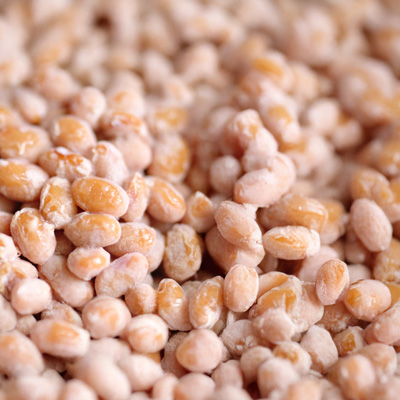
Did you know that one of the most exciting trends in the world of health has its origins on a Japanese breakfast table? That’s where natto is served. It consists of fermented soya beans that certainly have a character all of their own, both in appearance and smell. But don’t let first impressions fool you! In 1987, a researcher discovered a real gem amongst the sticky strands. A tiny bacterium called Bacillus subtilis natto is hard at work there, producing an enzyme that is now electrifying the scientific community. Nattokinase was born.
Biochemically speaking, this protein is a tiny, highly motivated pair of scissors just waiting to take a close look at protein structures in your body [1]. The fact that nattokinase isn’t technically a real kinase doesn’t bother anyone, as its talents lie elsewhere entirely. In research circles, this powerhouse is now being closely monitored worldwide, as it is suspected that these biological scissors could play a key role in the health of your blood vessels [2]. Even though science is only just beginning to unravel all the secrets of the bean, one thing is clear: this Japanese tradition is one to keep an eye on.
From the breakfast table straight into the bloodstream: the enzyme in action
So now we know that nattokinase comes from a sticky Japanese breakfast staple, but what exactly does this enzyme actually do in your body? You can think of it like this: in your blood, there is a constant tug-of-war between rigidity and pure fluidity. Fibrin plays a key role in this. This protein is essentially a biological glue that can be extremely useful, for example, in wound healing [3]. However, to ensure everything remains fluid, the body naturally breaks down excess fibrin. Experts refer to this delicate balance as fibrinolysis [3].
This is exactly where nattokinase comes in. As a specialised protein ‘scissor’, it has the ability to break down such protein structures in a highly targeted manner [1]. In initial studies, researchers have observed that the enzyme could be involved in precisely these processes within the body [4]. Whether and to what extent this actually makes a decisive difference in your daily life is currently the subject of lively debate. It is therefore not a medical therapy, but an extremely fascinating topic for anyone wishing to better understand their inner balance.
Where can you find nattokinase? The big food check
If you’re hoping that nattokinase is found in your cheese sandwich or morning yoghurt: sorry, no such luck! The enzyme is a real rarity in our Western diet. In the wild, you’ll actually only find it in its natural habitat: traditional Japanese natto. Only there can the bacterium Bacillus subtilis natto really run riot and produce the enzyme we’re after during fermentation.
You might be thinking: “Hey, I absolutely love miso soup or tempeh!” While that’s certainly delicious, it doesn’t help us here, unfortunately. These soya classics involve completely different microorganisms, which do a great job but simply don’t produce nattokinase. So if you’re keen on the enzyme, you’ve got a choice: either you give the sticky original from Japan a go, or you look for handy capsules. That way, you get the full dose without having to deal with the beans’ distinctive aroma first thing in the morning.
Who should take a closer look at the bean?
Nattokinase is particularly interesting for people who don’t wait until their body starts to fall apart before treating it like a temple. So if you make sure to get enough exercise and eat a varied diet, and want to proactively support your internal systems, this enzyme is definitely something for you. It’s a particularly fascinating area of research for anyone committed to healthy ageing and keen to keep an eye on their blood vessels. Important to know: We’re talking here about a complementary lifestyle factor, not a substitute for medical treatments.
What you should check before you start
Before you reach for a dietary supplement, there are a few points you should be particularly aware of. In the following situations, consulting your doctor is absolutely essential:
- Medication: You are already taking blood thinners or other anticoagulants.
- Surgical appointments: You have a surgical procedure coming up in your calendar.
- Pre-existing conditions: You have existing health issues that require professional assessment.
- Quality check: Look out for the specification in FU (Fibrinolytic Units). This unit indicates enzymatic activity, not the quantity in milligrams, and thus makes products easier to compare [5].
Between tradition and high-tech laboratories
So where do we stand today? Nattokinase has long since made the leap from the Japanese breakfast table to laboratories around the world. We are currently in an extremely exciting phase: science is providing us with ever more precise insights into how this enzyme interacts with our bodies [6]. Even though the really large-scale, long-term clinical studies are still pending and nattokinase therefore officially remains a dietary supplement, interest in this natural specialist is greater than ever before.
For you, this means: you have discovered a topic that perfectly combines tradition and modern research. It is not a standard medical treatment, but a valuable boost for anyone who wants to proactively support their body and maintain inner flexibility. The journey of the golden bean is far from over. On the contrary: it is only just beginning to find its rightful place in a health-conscious lifestyle.
Curious? You’ll find more fascinating articles on the subject in our magazine:
- Better oxygen supply in spring thanks to iron and vitamin C as natural boosters
- Vitamin D3 and K2: Your secret weapons against the winter blues and for strong bones
- Supporting circulation: With nattokinase and OPC
- Ashwagandha – a true all-rounder for health?
- Cardiovascular system: Our body in motion
FAQ – Frequently Asked Questions
How much nattokinase should I take each day?
The potency of nattokinase is measured in fibrinolytic units (FU) [7]. Many studies have examined doses of around 2,000 FU, but you should always briefly discuss your personal optimal dose with a healthcare professional [7].
Are there any known side effects of nattokinase?
So far, the available studies suggest that it is generally well tolerated [8]. However, as nattokinase is closely linked to blood clotting, an increased risk of bleeding cannot be entirely ruled out in some people.
How long does it take for nattokinase to take effect?
In some studies, changes in certain blood values were observed just a few hours after taking the supplement [9]. However, it is not possible to make a general scientific statement about whether and how quickly you personally will notice a difference, as every body reacts to the enzyme in its own unique way.
Can I take nattokinase instead of aspirin or other blood thinners?
A definite no. Nattokinase is a dietary supplement, not a medicine, so you must never replace your prescribed blood thinners without consulting your doctor. Please always discuss any changes to your treatment directly with your doctor.
What does nattokinase have to do with ageing?
Scientists are currently investigating whether nattokinase, through its influence on blood pressure and the biological balance in the blood, could be a useful aid for healthier blood vessels in old age [4, 7]. Although the initial results are extremely promising, the available data is not yet sufficient to support an official medical recommendation.
When should you take nattokinase?
There is no set time for taking it. Many people prefer to take it on an empty stomach or some time after a meal, so that the enzymes do not interfere with digestion. However, it is best to simply follow the recommendations on the packaging or check with your doctor.
How does nattokinase differ from omega-3 or vitamin K2?
Whilst nattokinase, as an enzyme, is specifically researched in the field of blood clotting, omega-3 and vitamin K2 address entirely different areas such as inflammatory processes or calcium transport. They act at different levels within the body and are therefore more like team players than directly comparable.
Sources:[1] https://www.sciencedirect.com/science/article/abs/pii/S0006291X83726240?via%3Dihub
[2] https://pmc.ncbi.nlm.nih.gov/articles/PMC5066864/
[3] https://www.sciencedirect.com/science/chapter/bookseries/abs/pii/S0065323305700085
[4] https://www.sciencedirect.com/science/article/abs/pii/S0271531709000220?via%3Dihub
[5] https://pubmed.ncbi.nlm.nih.gov/3478223/
[6] https://pmc.ncbi.nlm.nih.gov/articles/PMC6043915/
[7] https://pubmed.ncbi.nlm.nih.gov/18971533/
[8] https://www.sciencedirect.com/science/article/pii/S0278691515301344?via%3Dihub
[9] https://pmc.ncbi.nlm.nih.gov/articles/PMC4479826/